MID-QUARTER INSIGHTS
The traditional, pre-pandemic office model has been transformed by a post-hybrid work demand for flexibility and affordability for business teams and tenants, even within suburban markets like York and Lancaster Counties. Although many local businesses have called employees back to the office, demand for larger spaces has been noticeably reduced. Now with the arrival of AI in tandem with prolonged economic uncertainty, the office ecosystem’s evolution won’t be slowing anytime soon.
The value of in-person collaboration remains a recognized asset for local office users, but space allocation is no longer as easy or reliable as head counts or USF/person. Office space needs can fluctuate within hybrid work models, and investment and leasing gains are harder to project for businesses confronted with rising operational costs, economic instability and a recent concern for AI’s anticipated impact on future office workforce numbers.
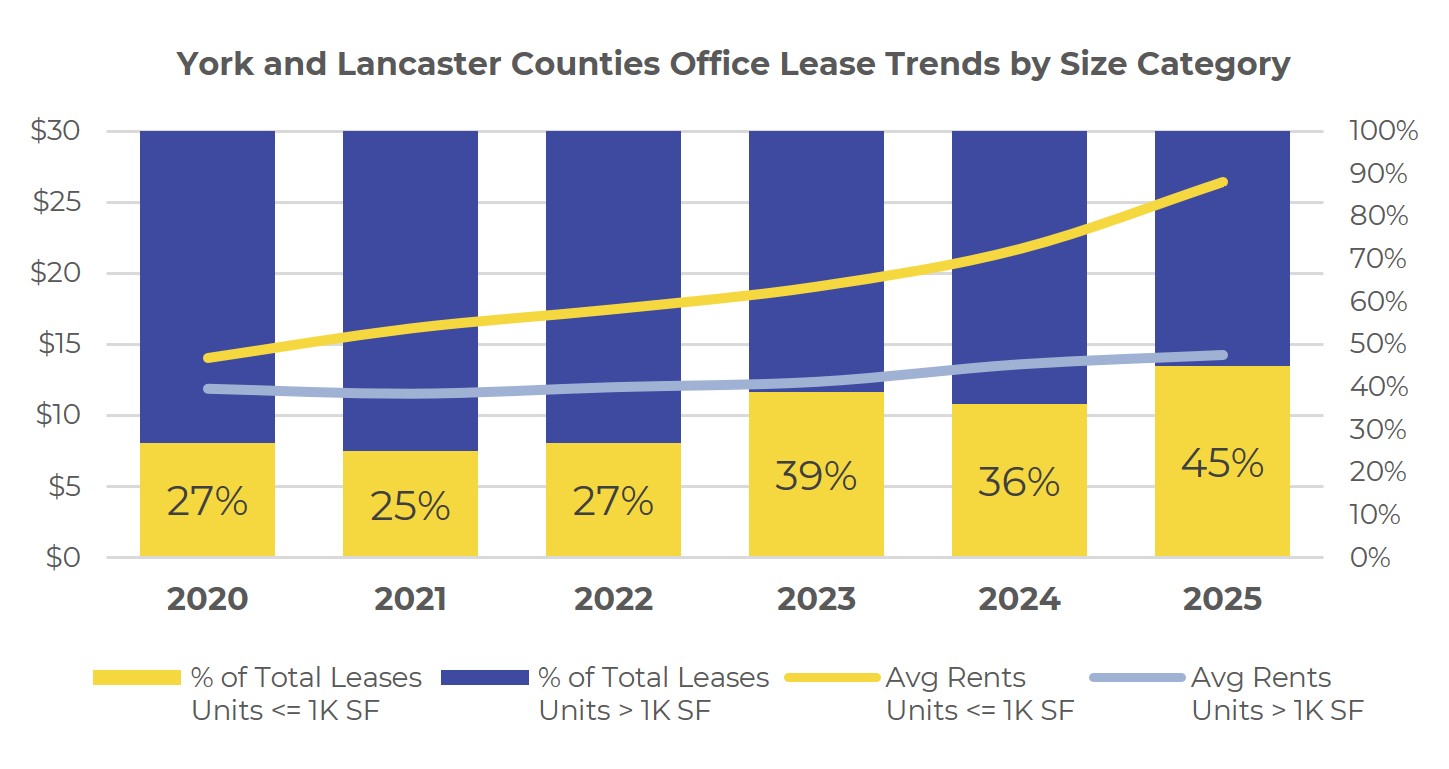
Cost-effective, single-office suites and co-working opportunities offer crucial scalability options with shorter, flexible lease terms favorable to smaller businesses that make up a notable portion of local office users. Leasing trends over the last five years support a significant shift in regional popularity for spaces under 1K SF. In 2020, units less than 1K SF accounted for 27% of the combined leasing volume for both counties. By 2025 that allocation has grown to 45%.
Growth of average lease rates for smaller units in York and Lancaster Counties has outpaced larger spaces by nearly double and risen an impressive 88% since 2020. This trend overwhelmingly affected York County’s office sector, revealing a 146% increase in average rents for units less than 1K SF compared to Lancaster County’s 38%.
FAQ | Commercial Real Estate Consulting
What are the typical services to expect from CRE Consulting?
CRE Consultants provide guidance to accomplish business strategy goals for investors through location analysis, site selection, investment analysis, development advisory, and portfolio and asset management services. Experienced consultants are typically connected to extensive partner networks including agents, developers, investors, lenders and other key industry professionals.
What are the major investment strategy benefits gained by CRE Consulting?
CRE Consulting offers a competitive advantage for property owners, investors, buyers and tenants seeking to evaluate their options, understand market trends and data, navigate financial analysis and more.
What is the difference between a consultant, an advisor and a broker?
An advisor combines the capabilities and experience of both a knowledgeable consultant helping the client through their decision process, and a broker handling the complex processes of negotiation and leveraging resources to successfully conclude a sale or lease.
ROCK’s team of real estate advisors provide consultation services that help clients make confident, informed investment decisions by enhancing their market knowledge with data-driven insights and analysis tools that mitigate risk and optimize revenue and returns on their portfolio investments.
ROCK TALK | Featuring Reed Gunderson, Brokerage Advisor
Q Despite a concentration of medical office users in York and Lancaster Counties, professional office properties make up the majority of overall inventory and are most affected by the recent leasing trends. Based on your experience within the current market, how should local businesses and investors evaluate the competitive positioning of traditional professional office assets against emerging flexible workspace models?
REED GUNDERSON “Coworking spaces and single-office communities are popular, but flexible workspace models are less ideal for local businesses that are operating multiple days on-site. Many local employers have called employees back to the office several days a week and many employees are choosing to work from the office beyond their hybrid schedule requirements, further reinforcing demand for quality, professional office space in the market.
Businesses and investors should identify outdated amenities that may not translate to today’s users. Things like oversized lobbies and reception areas or other irregular transitional areas creating wasted or awkwardly segmented spaces that limit employee traffic or collaboration.”
Learn more about Reed Gunderson.